Krasner and Pollock: Past Continuous– the exhibition marks a historic return: the first major New York presentation devoted to either artist in over two decades—and their first of this scale at The Met. Bringing together over 120 works from more than 80 lenders worldwide, it offers not merely a retrospective, but a recalibration.
There are few artistic relationships as mythologised—and as misunderstood—as that of Lee Krasner and Jackson Pollock. When they first encountered each other in New York’s charged pre-war art scene—brought into proximity through a 1942 exhibition organised by John Graham—they were not yet the towering figures art history would later canonise. They were, instead, two restless experimenters, searching for a visual language adequate to a fractured world.
Their marriage in 1945 and subsequent move to Springs, Long Island, marked not a merging but an intensification of their individual artistic pursuits. In that quiet, almost ascetic environment, their practices evolved in parallel—sometimes converging, often diverging—yet always in dialogue.
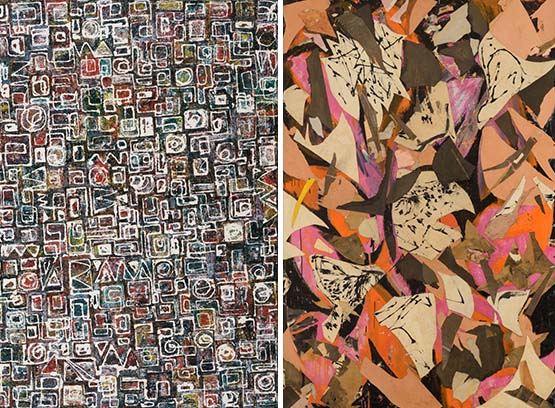
Pollock’s meteoric rise, fuelled by the radical invention of his drip technique, would secure his place in the mythology of American art. Krasner, who outlived him by nearly three decades, undertook a quieter but equally profound reinvention of her practice, pushing abstraction into new terrains of form, colour, and emotional resonance.
It is this dual narrative—of proximity without collapse, of influence without erasure—that forms the intellectual and emotional core of Krasner and Pollock: Past Continuous, the forthcoming exhibition at The Metropolitan Museum of Art.
Opening from October 4, 2026, to January 31, 2027, the exhibition marks a historic return: the first major New York presentation devoted to either artist in over two decades—and their first of this scale at The Met. Bringing together over 120 works from more than 80 lenders worldwide, it offers not merely a retrospective, but a recalibration.
Rather than rehearsing the familiar narrative that places Pollock at the centre and Krasner at the margins, the exhibition insists on a more rigorous proposition: that both artists stand as equals—partners in life and in the radical redefinition of abstraction.
As curator David Breslin suggests in essence, the exhibition begins with the premise that Krasner and Pollock were not only companions but co-architects of a new visual language. Each, in their own way, prioritised the demands of art above all else, seeking forms that could both draw from history and break decisively from it—particularly in the aftermath of global conflict.
Co-curator Brinda Kumar reframes this further: the exhibition resists collapsing their practices into a singular story. Instead, it follows two trajectories unfolding side by side—connected, yet distinctly evolving—bound by a shared commitment to testing the limits of abstraction through scale, material, and gesture.
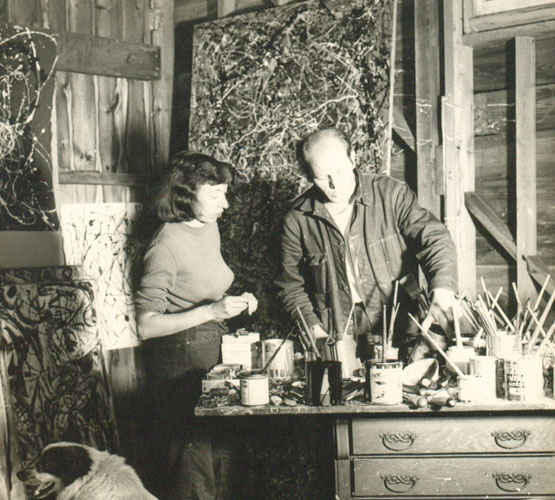
The exhibition unfolds across 12 chapters, tracing both artists from the 1930s through the postwar years and beyond. It reveals how their early influences diverged even as their ambitions aligned.
Krasner absorbed and negotiated the languages of the European avant-garde—engaging deeply with figures such as Pablo Picasso, Henri Matisse, and Piet Mondrian—while her training under Hans Hofmann shaped her disciplined yet exploratory approach to abstraction.
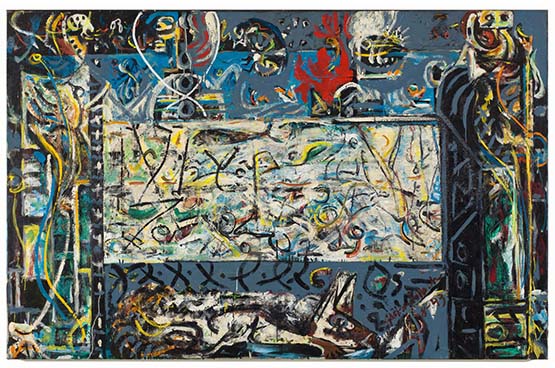
Pollock, by contrast, drew from a broader and more eclectic field: the regionalist narratives of Thomas Hart Benton, the scale and political urgency of Mexican muralism, the unconscious impulses of Surrealism, and even the creative energies within his own family.
These distinct lineages converged in what would become Abstract Expressionism—a rupture in the history of painting that replaced representation with gesture, and narrative with process.
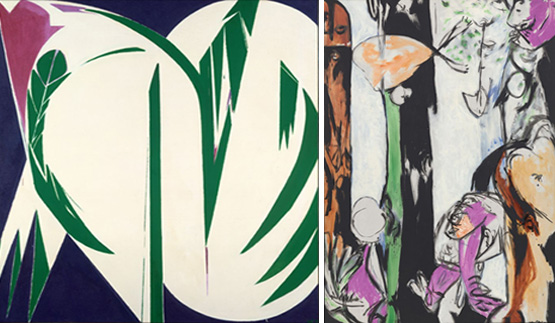
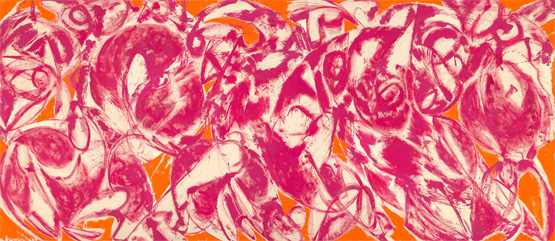
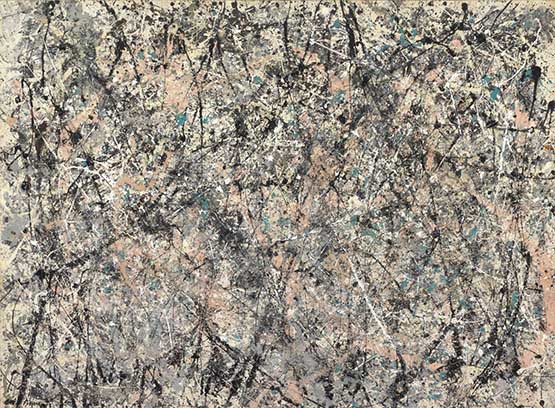
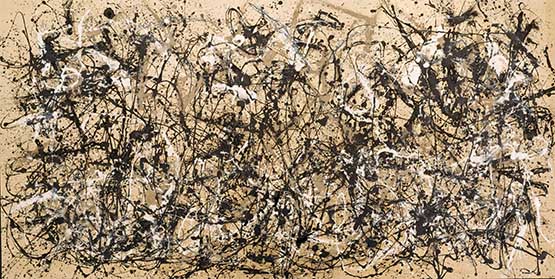
Pollock’s breakthrough—the drip technique developed between 1946 and 1951—redefined the act of painting itself, transforming the canvas into an arena of movement and gravity. Krasner, meanwhile, refused stylistic fixity. Her work moved restlessly across modes: from the intricate Little Images to bold collages, gestural canvases, and later, luminous hard-edge compositions.
The exhibition also confronts one of modern art’s most persistent imbalances. In 1949, LIFE magazine famously asked whether Pollock was “the greatest living painter in the United States,” a moment that crystallised his public myth. His early death in 1956 only amplified this aura.
Krasner’s contributions, by contrast, were long overshadowed—despite the fact that the decades following Pollock’s death marked some of the most daring and expansive phases of her career.
Past Continuous seeks to correct this historical distortion. It foregrounds Krasner’s work not as an adjunct to Pollock’s, but as a central force in the evolution of modernism—while also deepening our understanding of Pollock’s own complexity beyond the familiar narrative of heroic spontaneity.
The exhibition’s structure reflects its thesis. Some galleries place the artists in direct conversation; others allow for solitary encounters. This rhythm—of exchange and separation—mirrors the dynamics of their relationship. Anchoring the presentation are landmark works:
Krasner’s
Pollock’s
These works are not presented as isolated masterpieces, but as nodes within an ongoing dialogue—across time, across influence, and across memory.
The exhibition’s subtitle, drawn from a 1976 Krasner painting, is particularly resonant. “Past Continuous” suggests not a closed history, but an unfolding one—where artistic lives persist, echo, and transform long after their moment.
The exhibition also deepens the historical relationship between these artists and The Metropolitan Museum of Art itself. Pollock first exhibited there in 1943, later becoming part of “The Irascibles,” who challenged the institution’s stance on contemporary art. Ironically, the museum would go on to acquire Autumn Rhythm (Number 30) (1950), one of his most iconic works.
Krasner’s connection is equally profound. The Met holds a significant body of her work, including pieces gifted during her lifetime, and even hosted her memorial service in 1984. This exhibition, therefore, is not merely a presentation—it is a homecoming, a re-inscription of both artists into the institution’s evolving narrative.
As director Max Hollein has articulated in spirit, the exhibition reflects The Met’s broader commitment to re-examining modern art through fresh scholarship—placing Krasner and Pollock within a wider cultural and historical framework while reaffirming their continued relevance for future generations.
Artwork Picture Copyrights: © 2026 Pollock-Krasner Foundation / Artists Rights Society (ARS), New York.</p>
Enjoyed reading the article- “Krasner And Pollock In A Special Exhibition At The Met- The First Major New York Presentation?” Drop us a comment and let us know!