Art Street| India Art Fair 2026: Continuing the Narrative of Indian Visual Culture | GlobalFashionStreet.com
There is something almost ritualistic about the annual return of India Art Fair — a gathering that has, over the years, moved beyond being an exhibition into becoming the changing face of India’s contemporary cultural psyche. In 2026, the fair did not merely occupy space; it activated it. It reminded us yet again that while the global art circuit may dictate trends, India continues to generate its own grammar of visual urgency.
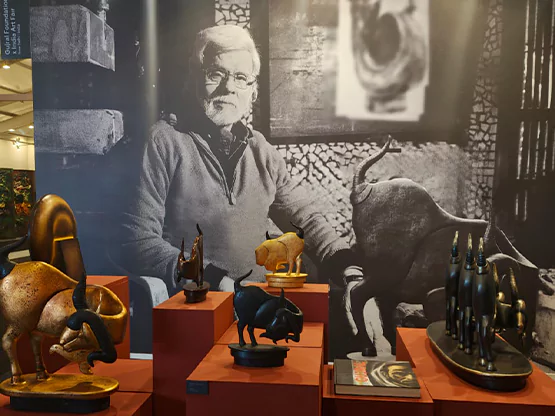
This year, the most perceptible shift was spatial rather than transactional. Art installations broke free from the inertia of passive viewing and leaned decisively into interactivity. Viewers were no longer spectators but participants — walking through, sitting within, negotiating, even inhabiting the works. The fairground felt more like a lived environment.
And yet, the galleries — steadfast in their commercial conservatism — continued to present works that felt reassuringly familiar. Blue-chip predictability hung comfortably on pristine walls. But if the gallery section seemed reluctant to take risks, the design segment emerged as the insurgent voice of the fair — experimental, tactile, and refreshingly unburdened by the anxieties of legacy.
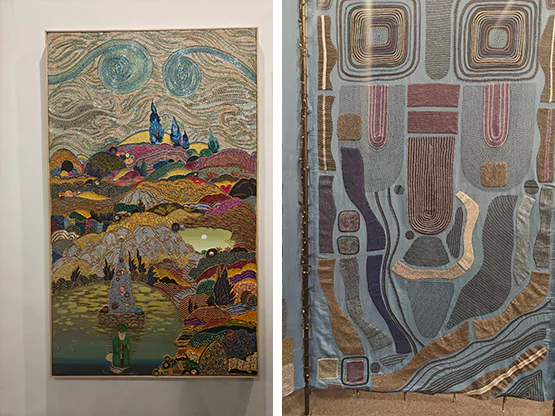
Among the most compelling ruptures was the work of Natasha Preenja, popularly known as Princess Pea. Her intervention quietly dismantled the long-standing hierarchies between tribal aesthetics and contemporary practice. Instead of “borrowing” from indigenous vocabularies, her work repositioned them at the centre — not as ethnographic curiosities but as living visual languages capable of holding conceptual depth. It was less about assimilation and more about assertion.
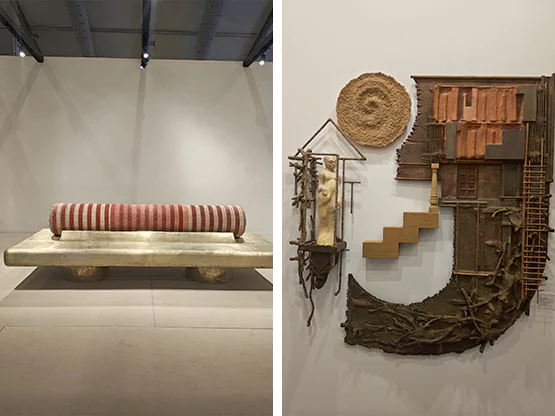
Similarly arresting was Debiprasad Bhunia’s ‘Between What is Built and What is Borne’. The work existed in a liminal zone — between structure and memory, between labour and inheritance. Bhunia’s visual syntax drew attention to the unseen burdens embedded within constructed environments, suggesting that architecture is as much carried by bodies as it is raised by tools.
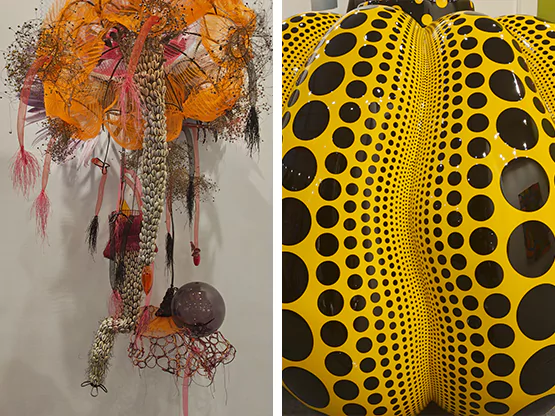
At the booth of OTA Fine Arts stood a commanding 2014 mixed media wall sculpture by Rina Banerjee. A dense orchestration of steel, plastic, nylon, light bulbs, shells, wire, cotton thread, and feathers, the work resisted singular reading. It shimmered between fragility and industrial excess — a reminder that contemporary identity is often assembled from the detritus of global consumption.
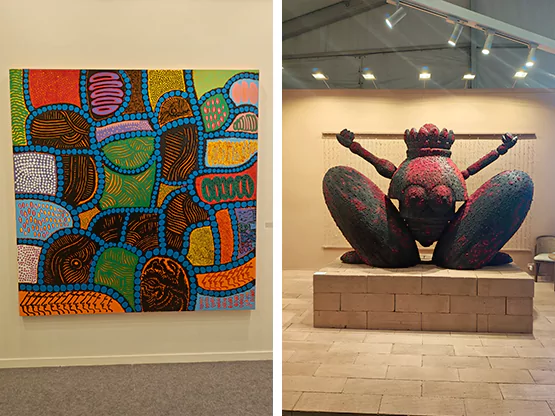
In a curious but effective juxtaposition, the same gallery also presented the iconic pumpkin by Yayoi Kusama in fiberglass reinforced plastic. While Kusama’s visual language is globally ubiquitous, here it functioned almost as a counterpoint — a polished, pop-inflected meditation against Banerjee’s layered materiality.
If one had to locate the fair’s most vital energy, it lay unmistakably within the design section.
The monumental ‘Bolster’ by Kunal Maniar and Associates transformed a familiar domestic object into an architectural proposition. Its modular seating possibilities encouraged collective inhabitation, dissolving the boundary between furniture and social sculpture.
From Gandhinagar, Morii Design presented ‘A Nomadic Dream’ — a collaborative work by Rabari women artisans from Kutch. The huge panels carried within them the quiet dignity of migratory memory, translating textile traditions into a contemporary spatial narrative without stripping them of their cultural agency.
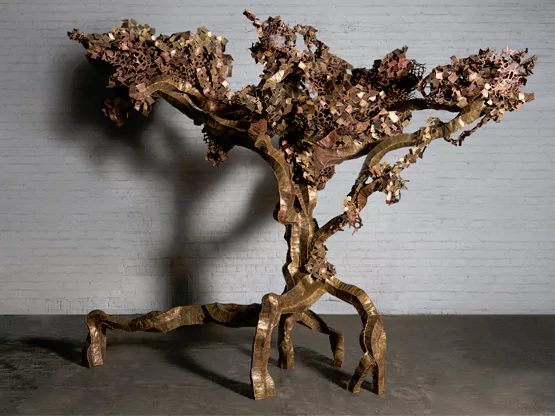
And then there was the tree — a radiant sculptural presence by Vikram Goyal. Neither botanical nor purely ornamental, it stood as a meditation on rootedness in an era of relentless mobility. Crafted with Goyal’s signature mastery over metal, the work felt less like an object and more like an axis around which the design segment revolved.
Beyond the fairgrounds, the capital itself became an extended site of engagement. Across New Delhi, parallel exhibitions, pop-up talks, studio visits, and gallery evenings unfolded in a carefully choreographed cultural overflow. The fair no longer exists as a weekend; it radiates into the city’s most prominent art spaces, turning January–February into a season rather than a schedule.
India Art Fair 2026 balanced artistic continuity with rising design prominence, reaffirming its role as a barometer of India’s evolving, hybrid creative consciousness.
If you enjoyed reading India Art Fair 2026- Continuing the Narrative of Indian Visual Culture, do drop us a comment.