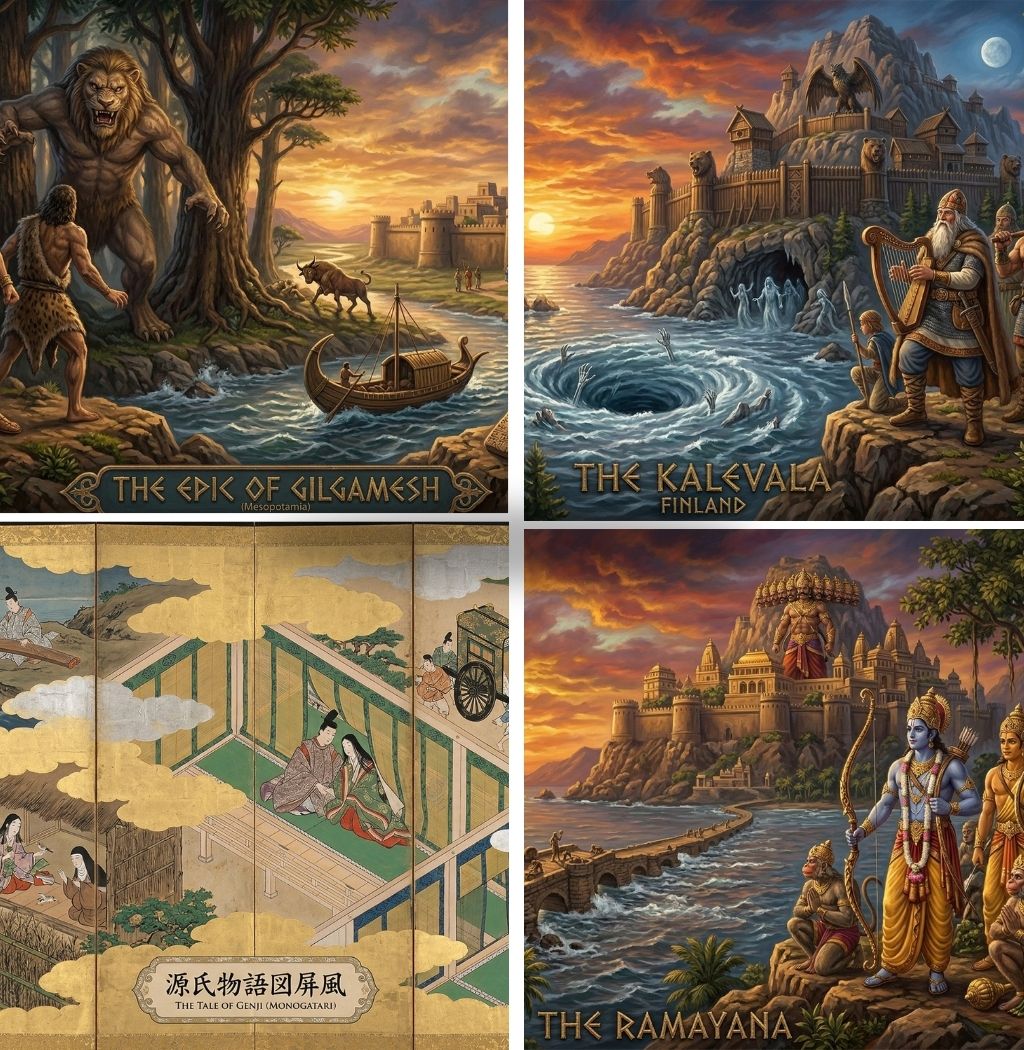
Long before stories were streamed, they were survived. Scratched onto clay tablets, sung across generations, painted into manuscripts, and whispered through memory—these were the narratives that built the emotional and moral architecture of human civilisation.
What makes them extraordinary is not just their age, but their persistence. You can still read them today, trace them in museum archives, and recognise their echoes in everything from cinema to fashion storytelling.
Often considered the world’s oldest surviving literary work (c. 2100 BCE), it tells the story of King Gilgamesh, his friendship with Enkidu, and his quest for immortality.
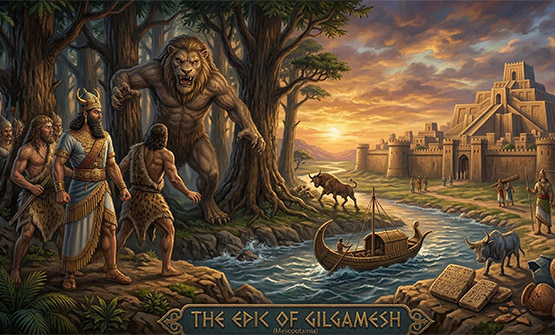
It begins, like many great stories do, with a man who believes he is untouchable. Gilgamesh, the king of Uruk, is powerful, restless, and excessive—until the arrival of Enkidu, a wild man created to challenge him. What unfolds is not rivalry, but one of literature’s earliest and most moving friendships. Together they conquer beasts and defy gods, but it is Enkidu’s sudden death that fractures the narrative—and Gilgamesh himself.
What follows is less an adventure and more a slow unravelling. Gilgamesh, unable to accept mortality, wanders into unknown lands in search of eternal life, only to encounter a truth that feels brutally modern: that death is the one story no one escapes. There is a quiet, devastating image—of him holding onto Enkidu’s lifeless body, waiting for it to stir—that lingers long after the epic ends.
Today, you can encounter this story through fluid modern translations by Andrew George, while fragments of its original clay tablets sit in the British Museum—still carrying the fingerprints of a civilisation trying to understand its own end.
2. The Iliad (Ancient Greece)
Attributed to Homer, this 8th-century BCE epic centers on the Trojan War, rage, honor, and fate—defining Western storytelling.
If Gilgamesh is about confronting death, the Iliad is about what happens when ego refuses to bend. At the centre of this vast war narrative is not strategy or victory, but Achilles’ anger—raw, consuming, and deeply personal. When he withdraws from battle over a perceived insult, the war continues without him, but so does the quiet accumulation of loss.
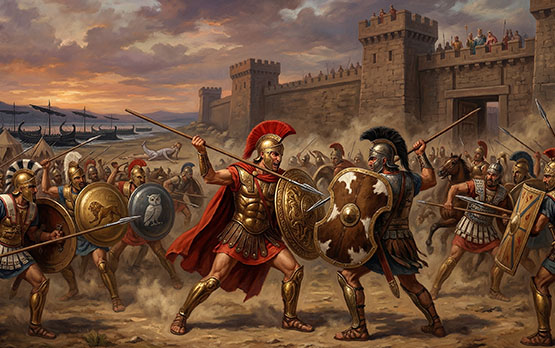
The genius of the Iliad lies in its refusal to glorify war. Even in its most heroic moments, there is an undercurrent of inevitability—men fighting battles they know they may not survive, driven by honour, pride, or simply the absence of choice. And then comes the moment that defines it: Achilles, having lost everything that tethered him to restraint, drags Hector’s body across the battlefield. It is not triumph—it is grief, distorted into violence.
Modern readers often discover the text through translations by Emily Wilson, whose language strips away distance and makes the emotional core startlingly immediate. Meanwhile, ancient manuscripts continue to be preserved in collections like the Vatican Library, bridging millennia of readership.
3. The Odyssey (Ancient Greece)
Also by Homer is generally dated to around the late 8th century BCE, most commonly c. 700 BCE.
This is the legendary tale of Odysseus’ long journey home—full of monsters, gods, and temptation. Where the Iliad is contained within the chaos of war, the Odyssey stretches outward—into oceans, islands, and the unpredictable terrain of the self. Odysseus is not just trying to return home; he is being tested, again and again, on whether he still deserves it.
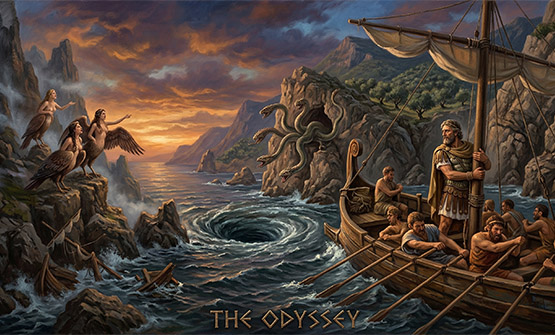
What makes this story enduring is its understanding of temptation. Each stop on Odysseus’ journey offers a version of escape—a life of ease, immortality, or oblivion. The Sirens promise knowledge so seductive it becomes fatal; Circe offers transformation; Calypso offers eternity. But every choice to stay is, ultimately, a choice to disappear.
And so the journey becomes psychological. By the time Odysseus reaches home, he is no longer the man who left—it is not just distance he has travelled, but identity. That idea—that home is something you must earn back—still resonates deeply.
Today, the Odyssey lives on in accessible translations, especially those by Emily Wilson, and in countless reinterpretations across film, theatre, and literature.
4. The Ramayana (India)
In the Hindu tradition, the Ramayana is believed to be set in the Treta Yuga, one of the four cosmic ages. This places the story thousands (even lakhs) of years ago, in a sacred, non-historical timeframe. Attributed to Valmiki it was composed roughly between 500 BCE – 100 BCE. Evolved over time through oral storytelling before being written down in Sanskrit.
This epic narrates the life of Rama, Sita, and the battle against Ravana—deeply embedded in Indian cultural consciousness.
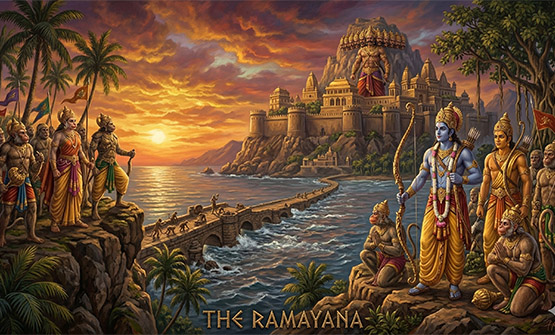
At first glance, the Ramayana reads like a story of exile and rescue. But beneath its sweeping narrative lies a more complex tension: what does it mean to do the right thing, when every choice comes at a cost?
Rama is often seen as the ideal hero, but his journey is defined as much by loss as by virtue. Sita’s abduction sets the stage for war, yet it is the moments in between that carry emotional weight—the quiet endurance of exile, the unwavering loyalty of Lakshmana, and above all, Hanuman’s devotion. His leap across the ocean to Lanka is not just a physical feat; it is belief made visible, a moment where faith transforms into action.
What makes the Ramayana so alive today is its multiplicity. It exists not as a single fixed text, but as countless retellings—each region, each culture shaping it anew. Editions from Gita Press sit alongside performance traditions, while visual interpretations are preserved in places like the National Museum.
5. The Mahabharata (India)
In Hindu belief, the events of the Mahabharata take place at the end of the Dvapara Yuga, just before the beginning of the Kali Yuga. Many traditional calculations place the Kurukshetra War around 3100 BCE (often cited as ~3139 BCE). This positions it in a sacred, cosmological timeline, not strictly historical. Composition Timeline (Scholarly View) Traditionally attributed to Vyasa Composed and compiled between ~400 BCE and 400 CE
One of the longest epics ever written, traditionally linked to Vyasa, exploring dharma, war, and fate. It includes the philosophical core, the Bhagavad Gita.
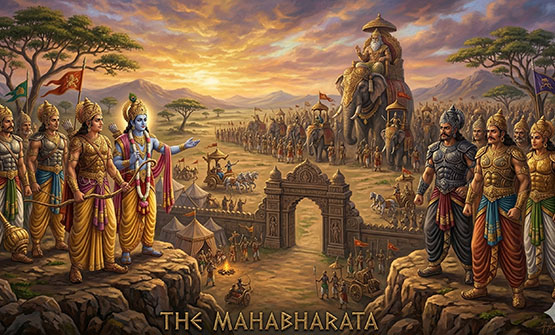
If the Ramayana seeks clarity, the Mahabharata dismantles it. Sprawling, layered, and morally complex, it refuses easy categorisation. This is not a battle between good and evil, but between perspectives—each justified, each flawed.
What makes it extraordinary is its willingness to pause even at the edge of war. As armies assemble on the battlefield of Kurukshetra, time seems to suspend itself. Arjuna, paralysed by doubt, turns to Krishna—and what follows is the Bhagavad Gita, a philosophical dialogue that reframes duty, action, and detachment.
And then the war begins—and nothing remains untouched by it. Victory does not feel like victory. Loss does not belong to one side alone. The Mahabharata lingers because it understands something fundamental: that human conflict is rarely clean.
Modern readers often enter this vast epic through accessible retellings like those by C. Rajagopalachari, before moving into fuller translations and archival material.
6. The Tale of Genji Monogatari (Japan)
Written by Murasaki Shikibu around 1008 CE, it’s often called the world’s first novel, capturing courtly life, romance, and melancholy in Heian Japan.
Long before the modern novel learned how to enter the human mind, The Tale of Genji was already there—observing, lingering, and understanding. Set within the refined world of the Heian court, it does not rely on war or spectacle, but on something far more delicate: emotional shifts, unspoken desires, and the passage of time.
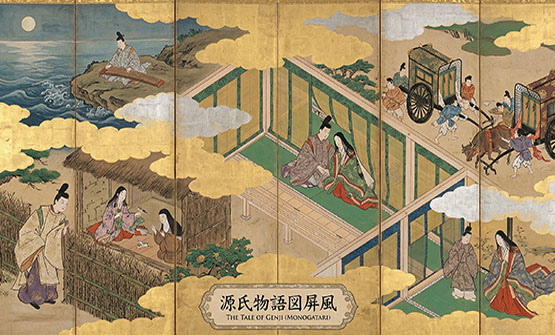
Genji himself is not a hero in the conventional sense. He moves through relationships, not as a conqueror, but as someone constantly searching—for beauty, for connection, for something that always seems just out of reach. The women in his life are not merely characters; they are reflections of longing, each encounter carrying a subtle melancholy.
What makes this work extraordinary is its sensitivity to impermanence. Moments are fleeting, love is often incomplete, and memory becomes as important as experience. It feels, even today, startlingly modern in its psychological depth.
You can read it now in elegant translations by Royall Tyler, while original illustrated scrolls remain preserved in Japanese cultural collections—reminders of a world where storytelling was as much visual as it was literary.
7. One Thousand and One Nights (Middle East)
Earliest roots trace back to around 8th–9th century CE. Derived from earlier Persian and Indian story cycles (notably a lost Persian work called Hezar Afsanah). Stories circulated orally across regions like Persia, India, and the Arab world.
The famous frame story of Scheherazade likely emerged during this phase. Later Expansion & Global Fame Introduced to Europe in the 18th century through translation by Antoine Galland. Storytellers added some of the most famous tales—like Aladdin and Ali Baba—later, which did not appear in the earliest Arabic manuscripts.
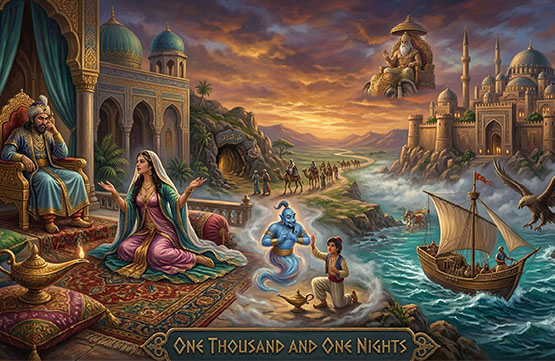
At its heart, this is a story about a woman who refuses to die—not through rebellion, but through narrative. Scheherazade marries a king who executes his brides at dawn, and instead of pleading for her life, she begins to tell a story. And then another. And another. Each night ends on a pause, a question, a thread left hanging—just enough to ensure she lives to see the next sunrise.
What unfolds is a labyrinth of tales: voyages, romances, tricksters, and magic lamps. But the real genius lies in the structure itself. Storytelling becomes strategy. Suspense becomes survival. The act of narration becomes power.
There is something deeply contemporary in this idea—that stories can shape outcomes, influence decisions, even delay endings. It mirrors the way narratives still function today, across media and culture.
Modern readers often turn to translations by Richard Francis Burton, though the text exists in multiple versions, scattered across Middle Eastern and European archives—each one slightly different, as if the stories themselves refused to stay fixed.
8. Beowulf (Anglo-Saxon England)
A heroic tale (c. 8th–11th century) of monster-slaying and mortality, central to early English literature.
On the surface, Beowulf offers everything a classic epic promises—monsters, battles, and a hero strong enough to defeat them all. But beneath that structure lies something quieter and more unsettling: an awareness that strength is temporary, and that even the greatest victories fade.
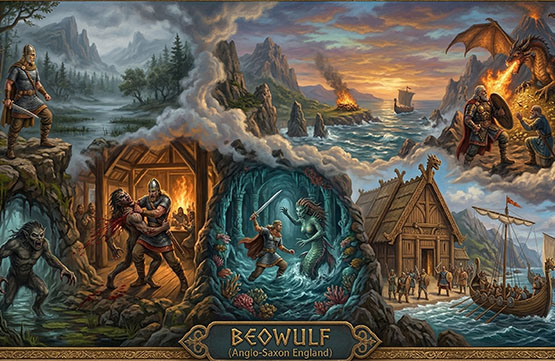
The most striking aspect of Beowulf is not its heroism, but its acceptance of decline. The final victory comes at a cost that cannot be undone, leaving behind not triumph, but memory.
You can experience it today through the deeply textured translation by Seamus Heaney, while the lone surviving manuscript rests in the British Library—a fragile bridge between past and present.
9. The Popol Vuh (Mesoamerica)
Recorded in the 16th century CE, preserving much older Mayan oral creation myths.
The sacred text of the Kʼicheʼ Maya, narrating creation myths and the adventures of the Hero Twins in the underworld. If many ancient stories look upward—to gods, to heavens—the Popol Vuh turns downward, into the underworld, where trials are not just physical, but psychological and symbolic. At its centre are the Hero Twins, who descend into Xibalba, a realm filled with traps, illusions, and tests designed to break them.
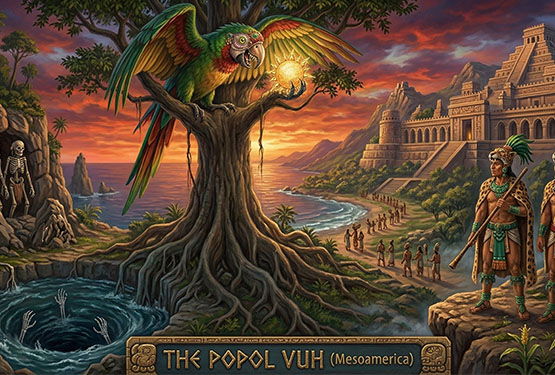
But this is not a straightforward battle of strength. The Twins win through wit, adaptability, and an understanding of the rules—often bending them in unexpected ways. Death is not always final, and defeat often carries the seed of transformation.
What makes the Popol Vuh fascinating is its tone. It is playful, strange, and layered with meaning, moving between creation myth and adventure with ease. It feels, in many ways, like an early form of speculative storytelling—rich with symbolism and open to interpretation.
Today, it is accessible through translations by Dennis Tedlock, with the original manuscript preserved at the Newberry Library. It is one of the few surviving records of pre-Columbian narrative tradition.
10. The Kalevala (Finland)
Compiled by Elias Lönnrot in the 19th century (1835–1849) from ancient Finnish oral folklore.
Unlike the others, the Kalevala does not emerge from a single voice. It is a tapestry, woven together from fragments of oral songs, gathered across landscapes and generations. What Elias Lönnrot created was not just an epic, but an act of preservation.
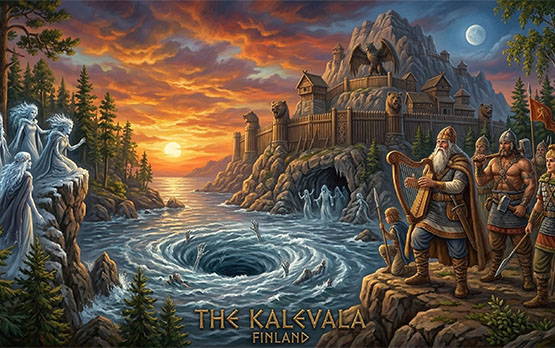
The narrative moves through myth and magic—heroes who sing reality into existence, objects like the Sampo that hold immense, almost abstract power. But what lingers is not just the story itself, but the sense that it could have been lost. That without intervention, these voices might have disappeared.
There is something deeply moving about that—the idea that storytelling is not just creation, but conservation. That culture survives because someone chooses to gather, to record, to remember.
Today, the Kalevala is widely available in translation, with its presence felt across archives, museums, and even contemporary design.
Taken together, these stories do not just belong to the past—they map the evolution of human thought. We are still asking the same questions. We are still telling the same stories.
Only the formats have changed.
Enjoyed reading ‘Oldest Stories of the World”? Drop us a comment and let us know!